
Your home’s foundation is a critical part of the structural integrity of your house.
Without a strong foundation, you will run into problems like moisture, cracks, sagging walls, non-functional doors and windows, soft spots, and broken floors in your house. No one wants these things, which means you have to stay vigilant, notice foundation problems, and get them fixed by a foundation repair specialist.
Not every crack is a cause for concern, but they all need to be evaluated.
Here are the different types of foundation cracks and how they can be fixed.
Vertical Cracks
Vertical cracks are cracks that go from the bottom of your wall to the top, or vice-versa. They are usually straight up and down, or if they’re diagonal, it’s only within 30 degrees or so of vertical.
A concrete foundation is strong against forces of compression, i.e. the weight of your home pushing down on the concrete. But it is weak against tension, which is when forces pull the concrete apart. That usually results in vertical cracks.
By themselves, vertical cracks are not that serious. You will probably have a few. The main concern is that they can allow moisture to infiltrate your home, so they need to be fixed. The fix is relatively simple and usually involves injecting urethane or epoxy into the crack.
Diagonal Cracks
More serious than vertical cracks are diagonal cracks. These are cracks that run from 30 degrees to 75 degrees from vertical. They can be wide or narrow. The narrow types are called hairline cracks.
The main cause of diagonal cracking is your foundation settling. When there is a difference between the original orientation of the foundation and where it is now, diagonal cracks can appear. This can happen if your home is old or new.
Foundations settle for a few different reasons. If your home is built against a slope, or if there is excessive moisture runoff near the base of your home’s walls, you can see settling. If the foundation is built on the wrong types of soil, or built on fill, then rain and temperature can cause the soil to contract or expand.
Diagonal cracks take more time and material to fix than vertical ones. It is also important to get a foundation repair specialist to identify why the cracks are happening and if anything can be done to stop it.
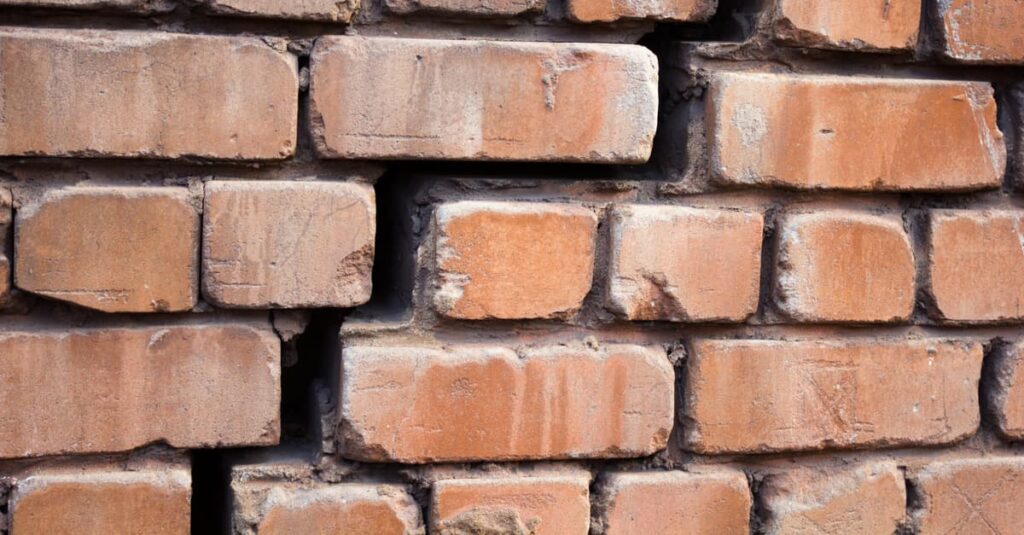
Note: There is a related type of crack called step cracks. You will notice a series of cracks running along your brick wall masonry joints like steps on a staircase. These are largely treated like diagonal cracks, but they can be more serious. Ask a specialist for guidance.
Horizontal Cracks
The most serious types of foundation cracks are horizontal cracks. These are running sideways nearly level with the ground.
The main cause of horizontal cracking is when your foundation bows. Improper construction is the main culprit. Improper drainage is another. Pressure against the outside of the wall causes the wall to bow inward, which results in the cracks you will see.
If you do not fix these cracks, and the forces that cause them, you could see something as severe as a home collapse through foundation failure.
Fixing these cracks is more difficult and takes more time and resources than the other types. It is not something you can do yourself. Repairs can be extensive, and often go beyond the foundation. Definitely call a foundation repair specialist if you see these cracks in your home’s walls.
If you notice any of these cracks in your foundation or wall, don’t delay – call a specialist. Delaying can result in damage to your home that will be more expensive to repair.
Southern Home Structural Specialists are foundation repair specialists who have the experience and skill to diagnose and repair foundation problems. Contact us for an evaluation of your home, or read testimonials from satisfied customers.
